©newenergybest
INFORMATION AND OPPORTUNITIES WITH NEW BEST ENERGIES

behind the news
Discover the opportunities of alternative energies
Air pollution: Deal with Council to improve air quality
THE NEW LAW AIMS TO REDUCE AIR POLLUTION IN THE EU TO ACHIEVE A CLEAN AND HEALTHY ENVIRONMENT FOR CITIZENS AS WELL AS ZERO AIR POLLUTION BY 2050


Strasbourg, europarl - February 21, 2024 - On Tuesday, negotiators from the Parliament and Council reached a provisional political agreement on new measures to ensure air quality in the EU is not harmful to human health, natural ecosystems and biodiversity with the aim to eliminate air pollution by 2050.
Stricter air quality standards and targets
The new rules set stricter 2030 limits and target values, compared to current rules, for several pollutants including particulate matter (PM2.5, PM10), NO2 (nitrogen dioxide) and SO2 (sulphur dioxide). For the two pollutants with the highest documented impact on human health, PM2.5 and NO2, the annual limit values are to be more than halved from 25 µg/m³ to 10 µg/m³ and from 40 µg/m³ to 20 µg/m³ respectively. There will also be more air quality sampling points in cities. The air quality standards shall be reviewed by 31 December 2030 and at least every five year thereafter and more often if clear from new scientific findings, such as revised World Health Organization (WHO) Air Quality Guidelines.
It will be possible for member states to request that the 2030 deadline to attain the air quality limit values be postponed by up to ten years, if specific conditions are met, including when the necessary reductions can only be achieved by replacing a considerable part of the existing domestic heating systems causing the pollution exceedances.
Better protection of citizens and access to justice
Co-legislators agreed to make currently-fragmented air quality indices across the EU comparable, clear and publicly available. These indices will also provide information about symptoms associated with air pollution peaks and the associated health risks for each pollutant, including information tailored to vulnerable groups as requested by Parliament.
It was also agreed that affected citizens and environmental NGOs, should be granted access to justice to challenge the implementation of this Directive in member states, and that citizens should be entitled to compensation when their health has been damaged due to the new national rules being violated.
Air quality plans and roadmaps
In addition to air quality plans, required for those EU countries exceeding limits, all member states will have to create air quality roadmaps by 31 December 2028 that set out short- and long-term measures to comply with the new 2030 limit values as proposed by Parliament.
Quote
After the deal was reached, rapporteur Javi López (S&D, ES) said: “Today’s agreement is a major step in our ongoing efforts to ensure a cleaner and healthier future for all Europeans. Parliament has played a crucial role in revising the outdated EU air quality standards, some of which were 15 to 20 years old, focusing on improved air quality monitoring near major pollution sources, protecting sensitive and vulnerable populations more robustly, and ensuring local authorities have the support they need to enforce the new standards effectively.”
Next steps
The deal still has to be adopted by Parliament and Council, after which the new law will be published in the EU Official Journal and enter into force 20 days later. EU countries will then have two years to apply the new rules.
Background
Air pollution continues to be the number one environmental cause of early death in the EU, with around 300 000 premature deaths per year (check here to see how clean the air is in European cities). In October 2022, the Commission proposed a revision of the EU air quality rules with more ambitious targets for 2030 to achieve the zero pollution objective by 2050 in line with the Zero Pollution Action Plan.
Agri-disasters costing trillions


CROPPED 25 OCTOBER 2023: AGRI-DISASTERS COSTING TRILLIONS - BANKROLLING DEFORESTATION - COP15 OFFICIAL FINALE
London, carbonbrief - October 25, 2023 - Agri disasters costing trillions: CATASTROPHE COSTS: Disasters have caused about $3.8tn worth of lost crops and livestock production over the past three decades, according to a new report by the UN’s Food and Agriculture Organization (FAO). The report, the first of its kind, looked at the impact of disasters such as floods, droughts and wildfires on agriculture and food security. It highlighted proactive ways to address agrifood system risks and ways to “mainstream disaster risk management”, FAO director general Qu Dongyu said in the foreword of the report. Overall, disaster-related losses have “moderately” increased since the 1990s, the report said, but “they have become more widespread in terms of the countries and products that they affect”.
IMPACTS: Extreme temperatures and droughts “inflict the largest impact per event” according to the report. It is “essential” to look at the interconnected nature of risks, the report noted, adding: “Climate change, pandemics, epidemics and armed conflict are all affecting agricultural production, value chains and food security.” Losses of cereal, such as wheat and maize, caused by disasters amounted to an average of 69m tonnes per year over the past 30 years – around the same as all of France’s cereal production in 2021, the report said. Meat, dairy and eggs accrued around 16m tonnes in losses each year.
FAO FALLOUT: Meanwhile, the Guardian reported that former FAO officials said they were “censored, sabotaged, undermined and victimised” for more than a decade after writing about and investigating the extent livestock contributes to methane emissions between 2006 and 2019. The allegations date back to the years after 2006 when a landmark UN report, “livestock’s long shadow”, was published. This report “pushed farm emissions on to the climate agenda for the first time”, the newspaper said, adding: “The officials described a culture in which attempts to probe the connection between livestock and climate change were discouraged and, in some cases, suppressed, and where management attempted to sabotage research and research networks.”
RECENT CHANGES: The 2006 FAO livestock report estimated that 18% of total greenhouse gas emissions come from livestock, mostly cattle. This figure was “revised downwards to 14.5% in a follow-up paper” in 2013, the Guardian said. Dr Anne Mottet, the FAO’s livestock development officer, “stressed that the changing figures reflected best practices and evolving methodologies”, the newspaper said. She told the Guardian: “Livestock is part of the FAO’s strategy on climate change and we work with governments and farmers and industry on this programme as well. We can’t ignore the main actors of the sector but there has been no particular pressure from them.” The newspaper said that the wider FAO declined to comment, along with several meat and dairy industry lobbyists.
Bankrolling Amazon destruction
‘GREEN BONDS’ INVESTIGATION: European banks Santander and UBS have allegedly raised hundreds of millions of pounds by selling “green” bonds, but some of these funds have gone to groups linked to Amazon deforestation and human-rights abuses, according to a new investigation from Greenpeace UK’s Unearthed and O Joio e O Trigo. Unearthed reported: “Among those linked to the bonds are a farmer who allegedly held five labourers in ‘slave-like’ conditions, a soy company identified as the biggest deforester in Brazil’s Cerrado savannah, a cattle rancher fined for preventing the regeneration of 17km2 of Amazon rainforest and an ethanol producer that poisoned a river relied on by an Indigenous community.”
BANKS’ RESPONSE: According to Unearthed, the financing was made possible by tools called “CRAs”, which are bonds specifically linked to Brazilian agribusiness. A spokesperson for Santander told Unearthed that CRAs are independently regulated and that it “has strong governance processes in place to ensure that required market standards are adhered to”. A UBS spokesperson told Unearthed that the bank “does not provide finance or advisory services to companies whose primary business activity is associated with illegal logging or high conservation value forest”.
AMAZON DROUGHT: Elsewhere, unprecedented drought in the Amazon continued to intensify. Earlier this month, the Negro River – the Amazon’s second-largest tributary – reached its lowest level since official measurements began 121 years ago, the Associated Press said. Reuters reported that human faces sculpted into stone up to 2,000 years ago have appeared at the edge of the Amazon River amid extremely low water levels. Bloomberg spoke to Brazilian atmospheric scientist Prof Paulo Artaxo, who said the drought is expected to “get worse” as no rainfall is projected “in the immediate horizon”.
Spotlight
COP15 official finale
In this spotlight, Carbon Brief examines the reaction to the conclusion of the COP15 meetings last week in Nairobi.
Although it has been almost one year since countries agreed to “halt and reverse” biodiversity loss by 2030, the meetings behind the UN agreement officially drew to a close last week.
Almost every country in the world signed up to the landmark Kunming-Montreal Global Biodiversity Framework (GBF) at the COP15 biodiversity summit in Montreal in December 2022.
Bernadette Fischler Hooper, the head of global advocacy at WWF International, said there “were no major breakthroughs, but also no catastrophes” at the talks. She told Carbon Brief:
“They couldn’t finish some of the outstanding business in Montreal, so they had to reopen the COP15 here [in Nairobi]. Then there were some elections that were still to be done and some other general orders of business.”
More than 700 people attended the meetings in Nairobi. The talks were two-fold – one was the resumed COP15 discussions and one was the 25th meeting of the Subsidiary Body on Scientific, Technical and Technological Advice (SBSTTA-25).
A number of elections were also held for different positions within the COP.
The SBSTTA discussions brought together scientific and technical experts to give advice on the implementation of the GBF. A global review of progress, which will take place in 2026, was among the key discussion points, Fischler Hooper said.
This review is “the equivalent of the global stocktake in the climate COPs”, she said, which will see nations assess movement toward climate goals at COP28 in Dubai this year. Fischler Hooper said:
“The technical experts and scientific experts discussed what should be in this report. So it was very focused on what that report should contain.”
There was “significant progress” in providing scientific, technical and technological guidance on implementation, according to the SBSTTA chair, Hesiquio Benitez, who ended his five-year run as chair last week. The recent assessment on invasive alien species was also discussed, alongside sustainable wildlife management plans and conservation. Countries welcomed the sixth assessment report from the Intergovernmental Panel on Climate Change (IPCC) and “expressed alarm” about the “accelerating negative impact of climate change on biodiversity”, a Convention on Biological Diversity (CBD) press release said. The interconnected nature of climate change and biodiversity was “hotly debated”, Fischler Hooper added. Delegates approved a draft recommendation on biodiversity and climate change in Nairobi. Nature-based solutions (NBS) continue to be a “contentious” topic causing “a lot of frustration on many sides”, Fischler Hooper said. The controversial concept was a dividing issue at previous COP15 discussions. NBS are essentially actions to protect, conserve and use ecosystems to address different challenges and provide benefits. (Read Carbon Brief’s Q&A on whether nature-based solutions help address climate change.) A location has yet to be confirmed for the next UN biodiversity summit, COP16, due to take place next autumn. Turkey withdrew as host due to the three earthquakes that hit the country in February this year, killing more than 50,000 people and displacing millions. The CBD said discussions are being held with other potential host countries. But if no frontrunner emerges by this December, the summit will likely be held again in Montreal, where the CBD is based. David Cooper, the acting executive secretary of the CBD, said in a press release that the biodiversity framework is “well and truly on the way to implementation” following last week’s meetings. But Avaaz, the campaign group, said documents remain with “a substantial number of brackets to be sorted out and resolved” at COP16 and earlier discussions next May.
The proposed indicators to measure implementation “risk being weak, especially for reviewing policies”, the Avaaz campaign director, Oscar Soria, said on Twitter.
News and views
VOICED OUT: An Australian referendum to set up an Indigenous advisory body to parliament failed with more than 60% of voters against the proposal, the Sydney Morning Herald reported. Indigenous groups described the outcome as “an unparalleled act of racism by white Australia”, according to the Guardian. The Central Land Council, one of four regional groups representing Indigenous affairs in the Northern Territory of the country, said: “We will keep fighting for equality, fighting for land, fighting for water, fighting for housing, infrastructure, good jobs, education, closing the gap – a future for our children.” (Indigenous peoples around the world play a key role in protecting as much as 80% of the world’s biodiversity.)
FOREST FOCUS: Civil-society groups are calling for “urgent” collective action to preserve three major tropical forest basins at a summit this week, Afrik 21 reported. The Three Basins summit – taking place over 26-28 October in Brazzaville, Republic of the Congo – aims to bring together leaders from the Amazon, Congo and Borneo-Mekong-south-east Asia regions to form a “global coalition”. Afrik 21 said the Eboko Foundation, a Congolese organisation, posted an “online call to action” with five priority areas, including the conservation and restoration of biodiversity in these regions. Carbon Brief will publish an in-depth article on the summit after it concludes.
‘CASH-FOR-CARBON HUSTLE’: The New Yorker has published a detailed long-read into how South Pole, the world’s largest carbon-offsetting firm based in Switzerland, “sold millions of credits for carbon reductions that weren’t real”. The article includes multiple interviews with the firm’s chief executive, Renat Heuberger, who told the publication: “We’re here to save the climate”. Previous media coverage investigating the practices of South Pole is included in Carbon Brief‘s map of the impacts of carbon-offsetting projects around the world.
‘ECO-CITY’ STAND-OFF: Around 7,500 Indigenous people could be forced off their land on the Indonesian island of Rempang to make way for a government-led “eco-city” project, BBC News reported. According to the publication, the government has secured Chinese investment to transform the island into an economic and tourist hub covering 7,000 of the island’s 17,000 hectares. The remaining 10,000 hectares will be protected forest cover, according to the plans. BBC News reported: “These ambitious plans require everyone who calls Rempang their home to leave. Many of them belong to seafaring Indigenous communities who have lived here for more than two centuries.” The broadcaster spoke to multiple families who are refusing to leave.
DELTA ‘EXTINCTION’: Coastal communities living in Nigeria’s low-lying Niger delta are at risk of “extinction” because of climate change, local civil-society groups have warned, according to a report in the Nigerian publication Business Day. It reported: “Godson Jim-Dorgu, executive director of Mac-Jim Foundation, said the coastal communities within the Niger delta would be wiped away sooner or later due to the effect of climate change.” The comments were made during a one-day meeting on climate change and gender in Port Harcourt, the capital of Nigeria’s Rivers State.
Plogging
For The Planet:
An Interview With Paul Waye
This curious mix of sport and environmentalism is quickly gaining ground.

Amsterdam, impakter - October 23, 2023 - Paul Waye (@wayeoflife) is a Dutch-British marathon runner who decided to turn his passion for running into a crusade against rubbish by plogging. Plogging is a combination of jogging with picking up litter. It started as an organized activity in Sweden a few years ago and spread to other countries around the world in response to the growing concern around plastic pollution. An estimated 2,000,000 people plog daily in 100 countries and some plogging events have attracted over 3,000,000 participants. We chatted with Paul to learn more about this interesting mix of sport and environmentalism that’s quickly gaining ground.
How did you get into plogging?
I started taking it seriously for environmental reasons back in 2011 with my first plogging tweet, although the word didn’t exist back then, so I simply said “look what I picked up while on my run commute.”
Why did I start doing it? I was running along a country lane seeing all the trash in the hedge and thought, “If I don’t pick it up, then who will?”
Like most ploggers, I started by doing it every now and then (a couple of times a week), but in 2019 I made a deeper commitment to myself, to do it every time I play sport. And as I run nearly every day, it has become a daily activity. Just from plogging during my runs I pick up over 100kg of rubbish a month!
What is your goal and who is your audience?
Great question! It has actually changed. Originally I wanted to encourage people to be more aware of the trash problem and take action. I don’t want people to do as much as I do, but to just pick up one piece on a run. With over 600 million runners in the world, we have the numbers to create change!
So, I set out on a journey to inspire. But it has changed over time. I started bringing more of my personality into my posts to try and reach a wider audience but realised from people’s comments that an important part of what I do is to make fellow trash warriors smile. To laugh. And to recharge their batteries which are often depleted.
What has been the biggest learning curve in your professional growth?
Not sure. I don’t think I can really name one thing but instead will say that it is a constant learning opportunity. So, it is made up of constant small learning curves.
What are the biggest misconceptions about what you do?
People think of it as a hobby! It isn’t! While I do find it incredibly rewarding to plog, my real passion is running. I would much rather just run and NOT pick up trash! But the commitment is to my kids and to the planet. So, I will continue to do this as long as needed to.
What’s a day in your life like?
Plogging is done in my free time. I am a full time IT business analyst. So my day is like anyone else’s really, except that I get up earlier to run, pick up trash and post my adventure on social media. I find that important. 99% of my social media posts are selfies and taken on the day. I want people to see that I am doing this every day. One thing that is unusual is that on Saturdays I recreate a movie poster. But I put a plogging twist on it. (So instead of holding a gun, I am holding a gripper with a piece of trash). Those do take a lot of time to recreate, sometimes eight hours, as I first need to collect the trash, take the photos and then create and edit my poster.
Who inspires you?
Most people in some way. There is the potential for good in all of us. And I love how we inspire each other. If I am plogging and someone shouts out “well done!” then maybe I have inspired them. But one thing is certain, they have inspired me to continue. To do more.
Who is someone you want us to know?
I always tell people @cleanmiamibeach @thetrashtraveller, I love them so much. It feels like we have been on this journey for years. But I would also include @ironrootsathletics (tell Eric I sent you), a small vibrant young company dedicated to sustainable plastic free sportswear. Love their gear.
One sustainable product you can’t live without?
Reusable beakers. I have a water bottle and coffee breaker in my bag at the moment (I’m currently sitting on a train). I will also add during the pandemic it has also been a small metal clip, like a clothes peg. I used it while plogging to pick up single use masks thrown on the ground as trash. The clip meant I felt safe picking them up with it and have been able to plog through the pandemic risk free. Litterbugs didn’t stop dropping litter during lockdowns.
One eco-friendly habit you wish everyone practiced?
Yep, it’s going to be the reusable water bottle again. I don’t understand single use water bottles in most countries.
What does sustainability mean to you?
A future for my kids. A future for us all.


ATTENTION TO AIR QUALITY IS HIGHER IN LOW-MIDDLE INCOME COUNTRIES
Air quality,
G20 and EU
forget it in climate commitments
Berkeley, rinnovabili – October 18, 2023 - Although almost all the countries that have presented voluntary national contributions with the measures they intend to adopt to combat the climate crisis mention the issue of air pollution, few are those that envisage truly effective measures. A report by the Global Climate and Health Alliance draws up the ranking: the EU scores just 2 points out of 15. Attention to air quality is higher in low-middle income countries. Climate commitments forget air quality. Out of over 180 countries, very few states have measures against greenhouse gas emissions and other pollutants capable of truly reducing air pollution. And Europe is at the global bottom. This is stated by an analysis by the Global Climate and Health Alliance (GCHA) which has sifted through the voluntary national contributions (NDC), the non-binding programmatic documents that each country deposits with the UN Framework Convention on Climate Change (UNFCCC) and in which the measures that are intended to be taken to combat the climate crisis are exposed. NDCs were evaluated based on their focus on five categories: health impacts, air pollution, source sectors, economics and finance, and bonus points. For each category the maximum vote assigns 3 points, for a total of 15. The European Union, which presents a single joint NDC, stops at just 2 points, while the global average is slightly higher: 3.5.
The air quality ranking in the NDCs
At the top of the ranking are middle- and low-income countries with severe pollution problems. Attention to air quality in the NDCs is very high in Colombia and Mali, which lead the list with 12 points, and in Chile, Ivory Coast, Nigeria, Pakistan and Togo which follow with 10 points. At the other extreme there are 6 countries that scored zero points. These are Saudi Arabia (which is among the top ten global emitting countries for total emissions and per capita emissions), North Korea (which has the highest mortality rate from air pollution globally), Bahrain (the second highest high mortality rate from air pollution), Nauru, Palau and the Solomon Islands. “High-income countries fail to capture the co-benefits of clean air and the opportunity to maximize health gains from their climate commitments, with an average score of 2.9/15 points. Meanwhile, G20 countries that have submitted an individual NDC (all except Germany and Italy) score below average, averaging 3.3/15 points,” the report reads.


Greta Thunberg was arrested after taking part in a protest outside the London hotel where oil bosses hold an annual meeting
London, telegraph - October 17, 2023 - Protesters block access to oil summit in London. Dozens of protesters including Greta Thunberg blocked the road to a hotel hosting a major gathering of oil executives. The activists held banners and pink umbrellas with eyes painted on at both ends of Hamilton Place, stifling access to the InterContinental Hotel on Park Lane. They shouted “oily money out” and “cancel the conference”, while others lit yellow and pink smoke flares. A white fence surrounded the hotel entrance keeping protesters out while police smuggled conference attendees through the crowd of chanting activists and a samba band.
Miss Thunberg said: We cannot let this continue. The elite of the oil and money conference, they have no intention of transition. Their plan is to continue this destructive search of profits. That is why we have to take direct action to stop this and to kick oil money out of politics.
Police have confirmed they made 15 arrests outside the InterContinental London hotel in Park Lane this afternoon. They were held under the public order act, with one arrested on suspicion of criminal damage. Officers had already arrested six people this morning for obstruction of the highway. A statement from the Metropolitan Police said that officers imposed conditions on the protesters under the Public Order.


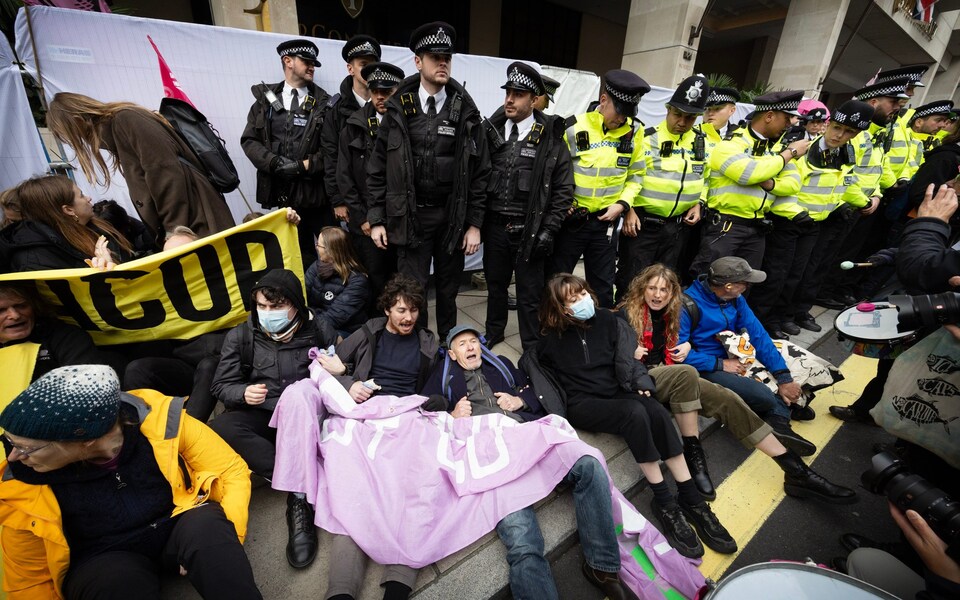
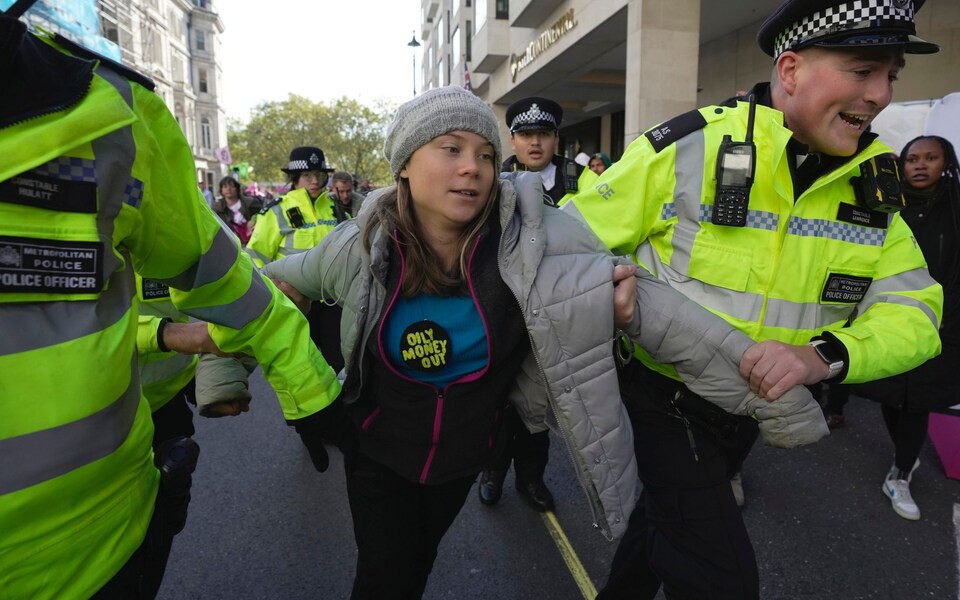
PROTESTERS BLOCK OIL EXECUTIVES FROM ATTENDING CONFERENCE
THUNBERG STANDS CALMLY AFTER BEING LED AWAY
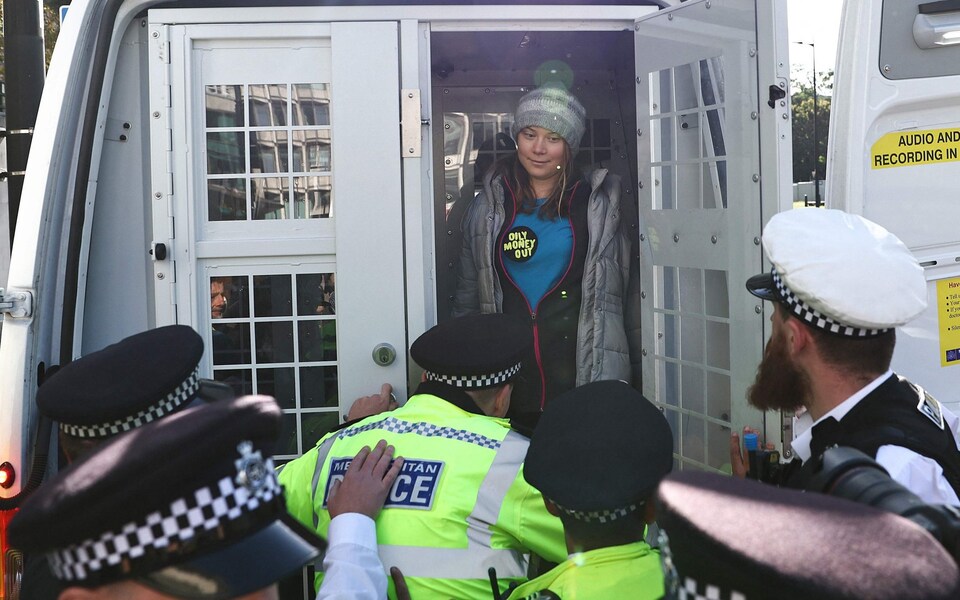
THUNBERG ARRESTED IN PROTEST EXPECTED TO LAST THREE DAYS
Video footage of her arrest showed Greta Thunberg, wearing a badge with the slogan ‘Oily Money Out,’ standing calmly as two police officers spoke to her. One was seen holding her arm. She had gathered with campaigners outside the Energy Intelligence Forum taking place at the InterContinental London hotel in Park Lane, where the speakers include net zero minister Graham Stuart. Mr Stuart has previously said that allowing oil and gas companies to continue drilling the North Sea for resources is necessary for energy security. Protesters and energy analysts have said any new fossil fuel projects, such as the Rosebank field approved last month, would have no immediate effect on consumer bills and would mostly be sold abroad. Lauren McDonald, a campaigner against Rosebank, said: The only reason that they continue to pursue this is for profit, there is no justification for this. So as we head into another round of climate talks, we are demanding that Norway - that wealthy happy country that is powered by green energy at home - we are demanding that Norway stops putting the brakes on other countries’ energy transitions. We are demanding that Norway stops profiteering while others around the world are struggling to pay their bills, struggling to live and struggling to survive in our destabilising climate.
Greta Thunberg was led away after taking part in a demonstration which campaigners say will run throughout the three-day meeting of the Energy Intelligence Forum.
Earlier, activists from Greenpeace abseiled down from the roof of the hotel to unfurl a banner reading “make big oil pay”, while a strong wind billowed the message and the protesters against the side of the building.
Ms Thunberg earlier told climate activists: We cannot let this continue. The elite of the oil and money conference, they have no intention of transition.
Their plan is to continue this destructive search of profits. That is why we have to take direct action to stop this and to kick oil money out of politics.
We have no other option but to put our bodies outside this conference and to physically disrupt. And we have to do that every time, we have to continue showing them that they are not going to get away with this.
Shell chief executive Wael Sawan revealed he will deliver his speech to the annual Energy Intelligence Forum in London remotely as he cannot access the hotel.
Protesters have been successful in disrupting the programme of events at the gathering of oil executives.
The chief executives of trading houses Gunvor and Trafigura missed their appearances at the conference because they were stuck outside the venue, according to Bloomberg News.
The organisers had earlier told anyone attempting to enter the Intercontinental Hotel to wait until more police officers arrived to disperse the protesters.
Police on the scene estimate that 200 to 250 protesters are blocking access to the venue.


THE EU DIRECTIVE HAS ENTERED INTO FORCE WHICH PROHIBITS THE SALE OF PRODUCTS CONTAINING MICROPLASTICS INTENTIONALLY ADDED TO PRODUCTS, IN ORDER TO REDUCE THEIR DISPERSION INTO THE ENVIRONMENT BY AT LEAST 30% BY 2030.
EU ban on products with microplastics. A step in the fight against environmental pollution
Strasburgo, huffingtonpost - October 17, 2023 - All products that contain harmful, insoluble and degradation-resistant synthetic polymer particles smaller than 5mm are targeted. Among the first interested are loose glitter, composed of polymers and aluminium, cosmetics, such as scrubs, lip gloss or toothpastes in which microplastics are used for exfoliation or to obtain specific consistencies, fragrances or colours, some types of products for cleaning, such as detergents, softeners, fertilizing and phytosanitary products; toys, medical instruments and, last but not least, granular infill materials, such as those used in artificial sports surfaces.
ECHA, the European Chemicals Agency, estimates that around 42 thousand tonnes of microplastics are released into the environment every year, found in the seabed, in water, in food and even in drinking water, representing a health risk of all living organisms since, in addition to damaging ecosystems, they risk entering the human food chain.
Already in 2017, when there was still no awareness of the real seriousness of the phenomenon, Marevivo put the spotlight on the problem, presenting - together with the support of other environmental associations - a bill to ask for a ban on microplastics in cosmetics. Proposal which was approved and entered into force from 1 January 2020, with the ban on marketing rinse-off cosmetic products with an exfoliating or cleansing action containing microplastics, as provided for in Article 1 - Paragraph 546 of the 2018 Budget Law. important milestone not only for the protection of the sea, but for our country, which was the first in Europe to legislate on the topic.
The new European measures, involving all the countries of the Union, represent an important goal towards the fight against plastic pollution but this is not enough. More drastic actions are necessary: in fact, the management of cosmetic products that do not require rinsing, such as lipsticks or nail polishes, remains pending, which - due to their low contribution to overall microplastic emissions and the potentially significant impact on the cosmetics products sector - they have not yet been regulated.
Microplastics have been found in our bodies, even in the placenta and blood. For this reason we must limit its dispersion into the environment. While waiting for further regulations in this sense, the choices of each of us become fundamental. We therefore reiterate the need to introduce more conscious purchasing habits in consumers, so that products on the market containing microplastics are identified by reading the components and discarded. Only the union of many small correct gestures can lead to real change.


Changing climatic conditions induce vegetation changes, which shapes human evolution
Chandigarh, downtoearth - October 7, 2022 - Climate has played a crucial role in shaping evolution ever since life on Earth began in the ocean about 3.5 billion years ago. Microbes were the earliest forms of life, paving the way for roughly 8.7 million species today. Down To Earth speaks with Rajeev Patnaik, professor at the department of geology from Panjab University, to understand how climate influences human evolution and if humans could evolve into a new species. Rohini Krishnamurthy: What role has climate change played in shaping human evolution? Rajeev Patnaik: Changes in water availability, rainfall, temperature and humidity, either globally or locally, can shape evolution. The origin and evolution of humans show many climatic changes over millions of years. Six million years ago, human ancestors separated from a branch consisting of chimpanzees and gorillas. This new branch became known as hominin, which includes humans, extinct subspecies and our immediate ancestors that could walk upright. This change corresponded to climatic changes. This change corresponded to climatic changes. We have evolved from unicellular organisms thanks to climatic conditions. If conditions had not changed, perhaps we would have only seen microbes in the ocean. If you look at life as a tree, the branches kept changing until humans reached a particular branch. The bacteria that did not change perhaps lived in a constant environment, so they stayed the same. If there are gradual changes in a population and a part of it lives in a region witnessing environmental changes, it gives rise to new species. There are two kinds of changes: Genetic and phenotypic [observable, physical changes]. Even now, genetic changes keep happening automatically. But they don’t necessarily translate to changes in the human body or physical appearance. Physical changes occur if there is a change in our diet or locomotion. For example, if a species ingests tough food, it will develop a heavy jaw. If it evolves to consume softer food, a heavy jaw is useless and it recedes. Simply put, if the climate does not change, humans or any living being will not evolve. When climatic conditions change, they induce vegetation changes, which have shaped human evolution. RK: Could you name one dramatic change in humans shaped by climate? RP: The most dramatic change was brain size capacity. That happened with our genus, Homo. The brain size of our ancestors belonging to the genus Australopithecus, Paranthropus or Ardipithicines were ape-like. They lived in climatic conditions that did not require a big brain. Their diet and lifestyle did not need that either. Approximately two million years, there were dramatic climatic changes. The conditions were not conducive to human survival. Hunter-gatherers had to move around, change their diet, communicate and develop strategies to hunt prey. They needed to build tools to survive. So humans began to use their brains more, which would have affected their organ size. The brain capacity almost doubled from Australopithecus. Within our genus, Homo habilis still had lower brain capacity. But the brain capacity of Homo Erectus and Homo heidelbergensis dramatically increased. We have seen this in our fossil record. RK: What about present-day changes in response to climate change? RP: In the present day, we see genetic changes. These changes allow people living in high-altitude regions or colder climates to live in extreme conditions. For example, the Eskimos have evolved to thrive in colder conditions for thousands of years. Tibetans also have a higher capacity to retain oxygen because they live at higher altitudes with low oxygen levels. It takes time for genetic changes to translate to changes that can be seen physically. Fossil records tell us that physical changes typically take 500,000 years to appear. Modern humans evolved somewhere around 300,000- 500,000 years ago. Around this time, we became distinct from Homo heidelbergensis. And it took almost a million years for heidelbergensis to separate from Homo erectus. Likewise, Homo neanderthalensis took hundreds of thousands of years to split from heidelbergensis. So physical changes occur gradually if climatic changes are also slow. Drastic changes can also occur, but climatic fluctuations occur at a rate of hundreds of thousands of years. By that standard, it would take 100,000 years for changes to show physically. The human body is complex and it takes millions of years for changes to occur. In contrast, insects evolve faster, where changes in size or colour can be recorded in short periods. RK: Do you expect a new human species to arise in the future? RP: New species can arise in the current period if a population become isolated. For example, if Inuit become isolated from civilisation and do not interact or interbreed, they may become physically distinct from the rest of the population. Usually, we see changes that begin with variation in a population, followed by races and sub-species. Finally, we have new species. In the past, we have some examples. Denisovans (who lived until 30,000 years ago from Siberia to Southeast Asia), were adapted to high altitude and low-oxygen conditions. This population gave rise to people living in high-altitude regions such as Tibet. RK: Europe, which is a cold continent, is increasingly becoming hot and dry. What does it mean to the people living there if these events become recurrent? RP: We will see genetic changes in Europeans if hot and dry conditions become recurrent. Around 13-14 million years ago, Europe was warm and humid. Roughly 16-18 varieties of Apes lived there. And then the climate changed, transforming Europe into a cooler place. All apes disappeared from the continent. Later, it became inhabited by Neanderthals, who adapted to colder climates. Much later, Homo sapiens came in. They were smart enough to adapt to changing situations. The climate governs every species. Homo sapiens migrated to greener pastures. Other human species died out because they could not adapt. Every species evolves in its niche. And if that niche becomes inhabitable due to climate change, the species will perish or migrate. Homo sapiens had all the resources to migrate long distances and adapt to changing conditions. If the climate in Europe continues to remain warm and humid, we may see changes in pigmentation or skin colour. Our ancestors came from Africa. Their pigmentation was brownish. Gradually, when people migrated to cooler conditions, people evolved lighter complexion. Cooler conditions, too, can bring about changes such as a higher accumulation of fat and changes in metabolism, and increased body hair. If Europeans interbreed with others, we might not see apparent changes, but if they stay isolated, we may see changes. RK: How does the ongoing climate crisis impact human survival? RP: Modern humans have interfered with the climate. We are to be blamed for so many drastic changes. But thanks to technology and modern medicine, humans have learned to survive. Even if something untoward were to happen due to climate fluctuations, there is every possibility that we would work around it. Humans may not go extinct. If we look at the past, we see Australopithecus thrived for millions of years. Elephants have survived for around 2.5-3 million years. Modern humans have been around only a few hundred thousand years. So, unless something dramatic happens, we won’t die out. But if tomorrow, we have an asteroid impact or humans kill each other, nothing can save us.
Fuelmakers’ biofuels investments dwarf hydrogen, study finds
Efforts to reduce fossil fuel use in transport overly concentrate on ramping up second-generation biofuels, neglecting synthetic fuels made with green electricity, according to a new study commissioned by green group Transport & Environment (T&E)


Brussell, euractiv - January 27, 2023 - The study shows that three-quarters of green investments in refineries go towards biofuels, eight times what is spent on the production of hydrogen and e-fuels. As pressure increases to reduce carbon emissions in the transport sector, experts agree that not all modes can be easily electrified. Additional alternative liquid fuels will be needed to replace kerosene in the aviation sector and heavy oil in the maritime sector, with some stakeholders calling for an increase in their deployment to reduce emissions from combustion engine cars.
Multiple options are currently being developed and scaled up, such as advanced biofuels made from plant residues, animal fats, and used cooking oil, and synthetic fuels made from hydrogen and CO2 extracted from the atmosphere (so-called e-fuels). However, a study by environmental consultancy Ricardo shows that most investments planned for refineries focus on biofuel production, rather than hydrogen-based alternatives.
While the planned investment into biofuel refining over the next seven years sums up to €28 billion, only €3.3 billion are expected to go into e-fuel-making. T&E accused oil companies of a mismatch between public statements and actual investment decisions. “Oil producers are promoting hydrogen as their big bet for the future, but in reality their investments in green hydrogen are pitiful,” Geert Decock, Electricity and Energy manager at T&E, said in a statement.
“This is not an industry pushing the boundaries of clean technology,” he added. The eFuel Alliance, an organisation promoting the use of synthetic fuels, told EURACTIV that this can be explained by the lack of incentives to scale up e-fuels. “It is obvious that investments will be lower if no legal framework is defined by the EU Commission,” said spokesperson Jan Wehrhold. “As long as the delegated acts are missing and REDIII [the EU’s renewable energy law] does not set clear requirements for green hydrogen and e-fuels, the investments will not materialise,” he added.
Investments in biofuels exceed sustainable capacity, T&E says. T&E not only criticised the lack of investments in synthetic fuels but also argued that the amount of biofuel that oil companies are aiming for would exceed what can be sustainably sourced by using waste and residues. The investments foreseen in fuels based on hydrotreated vegetable oil, for instance, would double production capacity in Europe from what it is now to 10 megatonnes by 2030, according to the organisation. “This is four times higher than what can be sustainably sourced in the EU,” T&E said, adding that “this will likely lead to limited ‘waste’ products like animal fats being taken from other industries, as well as mass imports of dubious used cooking oil from abroad”.
However, this claim is disputed by fuel makers and the biofuel industry, which points to a study commissioned by the business-funded research body Concawe. This “sets out clearly how there is substantial availability of sustainable biomass, mostly in the EU to make advanced biofuels up to 150 million tonnes a year by 2050,” industry group FuelsEurope told EURACTIV in an emailed statement. Marko Janhunen, Chair of the Advanced Biofuels Coalition told EURACTIV: “Advanced biofuels feedstock and various technologies exist today and are readily scalable. Feedstock is usually sourced locally.” “They can fast-track our efforts to reduce transport emissions and simultaneously reduce our dependence on foreign oil,” he added, pointing out that “while promising future solutions, e-fuels and hydrogen, on the other hand, are at a very early stage of development”.
To invest or not to invest? Advocates of e-fuels, meanwhile, seem perplexed by T&E’s call for more investments in hydrogen-derived synthetic fuels. “We welcome the fact that T&E is calling for more investment in hydrogen and eFuels, even if they see it differently in their position on the RED,” Wehrhold said. “There, T&E calls for only 1.6% green hydrogen and eFuels in 2030. The Commission proposal is 2.6% and was increased to 5% under RePowerEU, which is also our position,” he added. This was confirmed by Benedikt Heyl of T&E, who argues that e-fuels “should be used where direct electrification is not possible”, such as shipping and aviation, but there should be “no incentives for the use of e-fuels in road transport”. The €3.3 billion invested into the production of e-fuels so far however only represents a quarter of the production capacity that would be required to meet the target T&E is calling for, Heyl added.
“If most of the investment that goes into the (over)production of biofuels were redirected to the production of e-fuels, T&E would very much welcome this,” he said.
Attack on nuclear power plant.
Focus on renewable, clean and democratic sources
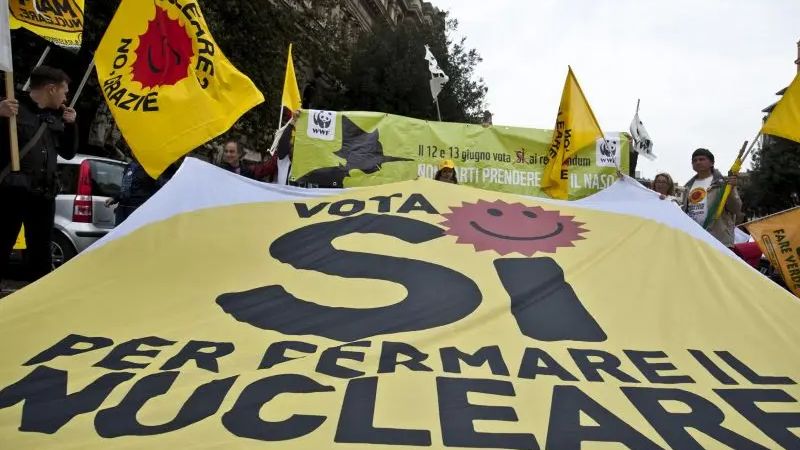
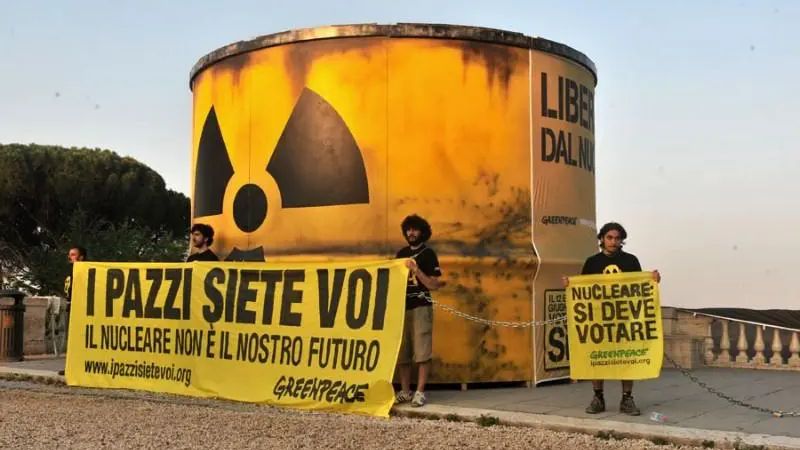
Italian people expressed themselves wisely and voted to stop nuclear power twice. Let's not go back
Rome, huffingtonpost - March 04, 2022 - One of the arguments on which Marevivo fought against nuclear power, the first in 1987 and the second in 2011 following the Chernobyl and Fukushima disasters, when the Italian people were called to give their opinion on the occasion of the two referendums , is precisely connected to what we experienced this night with the mortar attack on the Zaporizhzhia nuclear power plant, the largest in Europe.
These places of "clean and safe" energy production are not only at risk of human error in their management, in the disposal of waste or a natural event such as earthquakes, but they also represent a place susceptible to attacks by terrorism or pure madness, like those we are dramatically experiencing in this historical moment.
Luckily then italian people expressed themselves wisely and voted to stop nuclear power twice. Now this possibility has returned to the fore, environmentalists were and still are accused of raising barriers against this very dangerous and extremely expensive practice.
So?
We never tire of saying that the path to a future for the new generations can only be, without hesitation, that which leads us towards the production of energy from renewable and clean sources, which are also democratic because they are available to all the peoples of the earth.
Let's learn the lesson and move forward: new technologies, new patents, new productive jobs for all of humanity. And above all, stop the war!


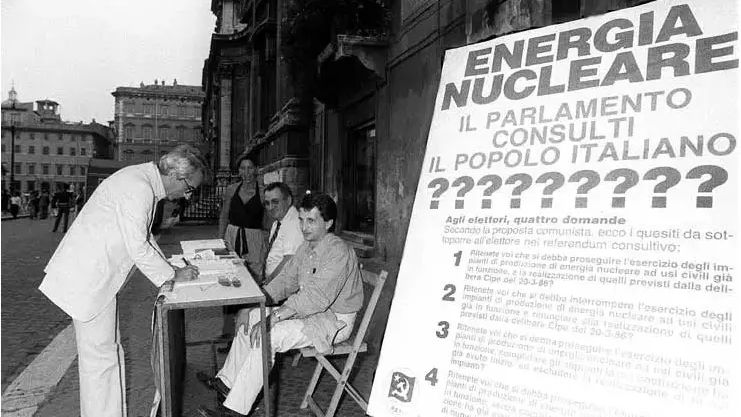
REFERENDUM 1987
REFERENDUM 2011
2023 CONTRO I REFERENDUM
L' 8 e il 9 novembre 1987 il popolo italiano si recò alle urne per votare 5 referendum-abrogativi. Tre dei quali riguardavano la situazione nucleare in Italia e il popolo italiano con 80,57% decise: NO AL NUCLEARE
Il 12 e il 13 giugno 2011, gli aventi diritto si reca alle urne per far pesare la propria volontà su quattro specifici passaggi normativi tra cui il Nucleare, e il 95% ha nuovamente espresso: NO AL NUCLEARE.
Il 21 settembre 2023 al Ministero dell’Ambiente si incontravano i protagonisti del nucleare made in Italy: "Enti pubblici nel settore della sicurezza nucleare e imprese che hanno programmi nel nucleare.
©newenergybest